

In just a few years, artificial intelligence has moved from being a futuristic idea to a daily workplace tool. Professionals are now using AI to write content, design visuals, analyze data, and even assist with coding. What once took hours can now be done in minutes with the help of generative AI tools.
This rapid shift is changing how businesses operate. Teams are expected to produce more content, make faster decisions, and manage increasing workloads. As a result, professionals across industries are turning to AI-powered tools to stay productive and competitive.
Generative AI tools are designed to create content, automate repetitive tasks, and assist with problem-solving. They can generate blog posts, marketing copy, images, meeting summaries, and software code. When used correctly, these tools help professionals work smarter rather than harder.
However, with hundreds of AI platforms available today, choosing the right ones can be challenging. Each tool serves a different purpose, from content creation and design to productivity and development support.
Understanding which generative AI tools are most useful is essential for anyone looking to improve efficiency and keep up with modern workplace demands. In this article, we will explore the most important generative AI tools every professional should know and how they can use them effectively.
What Are Generative AI Tools?
Generative AI tools are software platforms that use artificial intelligence models to create new content based on prompts or inputs from users. Instead of simply analyzing data, these tools generate text, images, code, audio, and other forms of content.
Most generative AI tools rely on advanced machine learning models known as large language models (LLMs) or diffusion models. These systems are trained on massive datasets and can recognize patterns in language, images, and structured data.
Because of this training, generative AI tools can produce highly realistic and useful outputs within seconds.
Common capabilities include:
- Writing blog posts, emails, or reports
- Generating marketing copy and product descriptions
- Creating design concepts or images
- Assisting developers with coding tasks
- Summarizing meetings or documents
- Automating repetitive business tasks
According to the U.S. National Institute of Standards and Technology (NIST), generative AI technologies are rapidly expanding across industries and are expected to significantly influence digital productivity tools in the coming years.
What makes generative AI tools powerful is their ability to support professionals rather than replace them. They help reduce manual effort, allowing people to focus more on strategy, creativity, and decision-making.
Design and Image Generation Tools
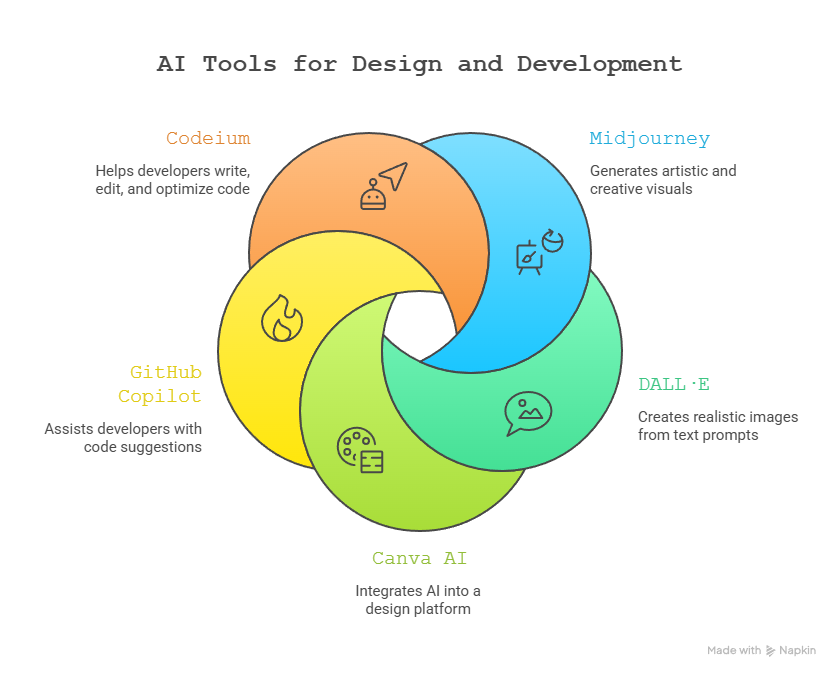
Visual content is essential for modern marketing and branding. These tools help designers and creators generate images, graphics, and creative concepts.
Midjourney
Midjourney is an AI image generator known for producing highly artistic and creative visuals. Designers and marketers use it to create concept art, illustrations, and visual assets for campaigns.
DALL·E
DALL·E can generate realistic images from text prompts. Users simply describe what they want, and the tool produces unique visuals within seconds. This is useful for marketing creatives, blog visuals, and design experiments.
Canva AI
Canva AI integrates artificial intelligence directly into a popular design platform. It offers tools like Magic Write, AI image generation, background removal, and automatic design suggestions. This makes it especially helpful for professionals who need quick visual assets without advanced design skills.
Coding and Development Tools
Generative AI is also transforming how developers write and manage code.
GitHub Copilot
GitHub Copilot acts as an AI coding assistant. It suggests lines of code, completes functions, and helps developers solve coding problems faster. Many software engineers use Copilot to reduce development time and improve productivity.
Codeium
Codeium is another AI-powered coding tool that helps developers write, edit, and optimize code. It supports multiple programming languages and integrates with popular development environments.
These tools allow developers to focus more on architecture and logic rather than repetitive coding tasks.
Productivity and Workflow Tools
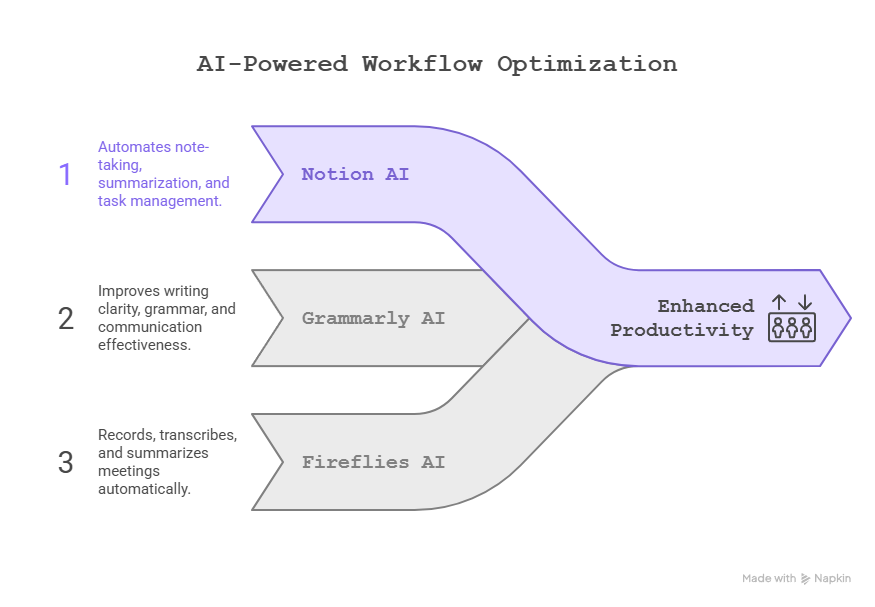
Generative AI tools also improve daily productivity by automating routine tasks.
Notion AI
Notion AI enhances the popular productivity platform by helping users write notes, summarize documents, generate task lists, and organize information more efficiently.
Grammarly AI
Grammarly AI helps professionals improve writing clarity, grammar, and tone. It also provides suggestions for rewriting sentences, making communication more polished and effective.
Fireflies AI
Fireflies AI is designed for meeting productivity. It automatically records meetings, transcribes conversations, and generates summaries with action items. This helps teams save time and avoid manual note-taking.
The growing use of these tools highlights how AI is becoming a core part of everyday professional workflows.
How Professionals Use Generative AI Tools in Real Work Scenarios
Generative AI tools are not just experimental technologies. They are already being used by professionals across industries to improve productivity and efficiency.
Marketing Professionals
Marketing teams use AI tools to generate blog posts, ad copy, campaign ideas, and social media content. AI also helps with keyword research, competitor analysis, and content planning.
For example, marketers may use ChatGPT to brainstorm campaign ideas while Jasper AI helps scale content production.
Developers and Software Engineers
Developers rely on AI coding assistants like GitHub Copilot to write code faster and debug errors. These tools suggest code completions and automate repetitive programming tasks.
This allows engineers to focus more on solving complex technical problems rather than writing basic code structures.
Designers and Creative Professionals
Designers use tools like Midjourney and DALL·E to generate creative concepts and visual inspiration. AI image generators can produce dozens of design variations quickly, helping creatives explore ideas faster.
This is especially helpful during early stages of brand or campaign development.
Business Professionals and Teams
Business leaders use AI to generate reports, summarize documents, and extract insights from large amounts of information.
Meeting tools like Fireflies AI automatically create summaries and action items, making team collaboration more efficient.
Freelancers and Entrepreneurs
Freelancers often manage multiple responsibilities, including marketing, communication, and project management.
Generative AI tools help them:
- Write proposals
- Create content
- Design marketing materials
- Automate communication
- Manage workflows
This allows small teams and independent professionals to operate with the efficiency of larger organizations.
These services help businesses adopt AI technologies effectively within their operations.
Conclusion
Generative AI tools are quickly becoming essential for modern professionals. They help automate repetitive work, generate content, support creative tasks, and improve productivity across industries.
From writing assistants like ChatGPT to design tools like Midjourney and coding assistants like GitHub Copilot, these technologies allow professionals to work faster and focus on higher-value tasks.
The key is not just knowing that these tools exist, but understanding how to apply them effectively in real-world workflows.
As AI technology continues to evolve, professionals who learn to integrate generative AI tools into their daily work will gain a significant competitive advantage.
Organizations looking to adopt advanced digital solutions can explore AI implementation and technology services through arista systems.
By embracing the right tools today, professionals and businesses can unlock new levels of efficiency, creativity, and innovation.
FAQs
Q) What are the top 5 generative AI tools?
A) Some of the most widely used generative AI tools include ChatGPT, Midjourney, DALL·E, GitHub Copilot, and Jasper AI. These tools support different professional needs such as writing content, generating images, assisting with coding, and creating marketing materials quickly and efficiently.
Q) What are generative AI tools?
A) Generative AI tools are software platforms that use artificial intelligence models to create new content such as text, images, code, audio, or videos. They analyze patterns from large datasets and generate outputs based on user prompts, helping professionals automate tasks and improve productivity.
Q) How are generative AI tools used in the workplace?
A) Professionals use generative AI tools to create marketing content, generate design ideas, write code, summarize meetings, and automate workflows. These tools help reduce manual tasks and allow employees to focus more on strategy, creativity, and decision-making.
Q) Are generative AI tools replacing human jobs?
A) Generative AI tools are designed to assist professionals rather than replace them. They automate repetitive tasks and provide suggestions, but human expertise is still essential for decision-making, strategy, creativity, and quality control.