
Most eCommerce businesses collect customer data daily but struggle to use it effectively. Repetitive support queries, abandoned carts, and poor product recommendations often impact conversions.
That’s why AI in eCommerce has become a major competitive advantage for online retailers.
According to recent industry data, 95% of U.S. eCommerce businesses reported a good-to-very good ROI after implementing AI technologies, especially in customer service, marketing automation, and analytics.
The impact of AI is visible across both B2C retail and AI in B2B eCommerce, where businesses use intelligent automation to improve bulk ordering, customer support, pricing, and account-based personalization.
The challenge for most businesses is not finding AI tools. It is understanding which AI solutions actually improve conversions, customer experience, and operational efficiency.
This blog explains how AI is reshaping eCommerce, the highest-ROI use cases, and how store owners can start adopting AI without building a large in-house engineering team.
What is AI in eCommerce?
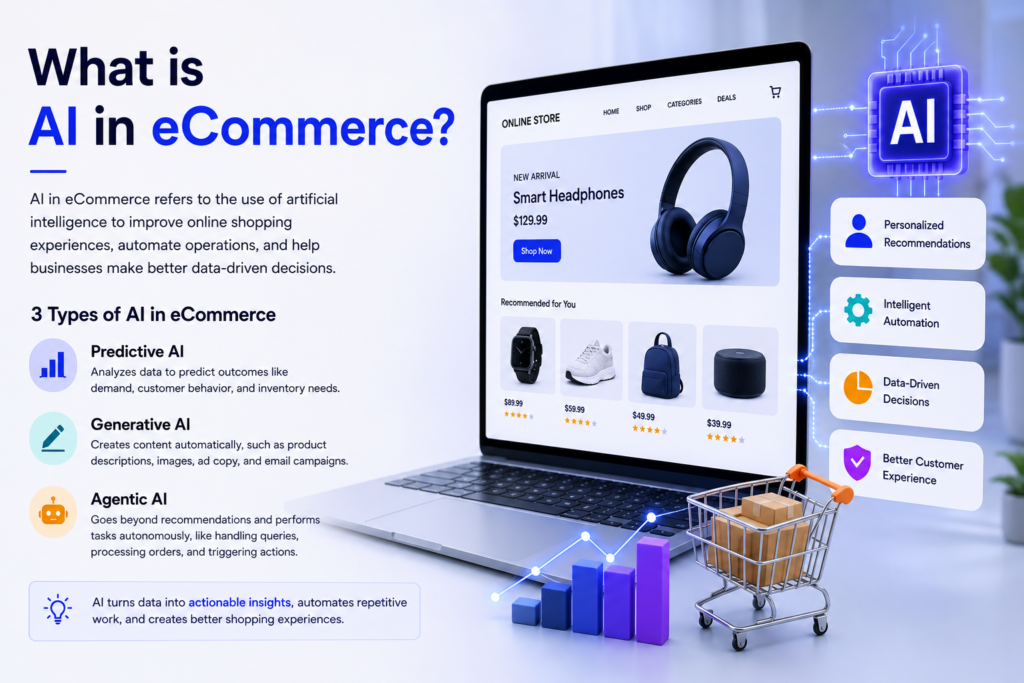
AI in eCommerce refers to the use of artificial intelligence to improve online shopping experiences, automate operations, and help businesses make better data-driven decisions.
Most store owners will encounter three major types of AI:
Predictive AI
Predictive AI analyzes historical and real-time data to forecast outcomes such as:
- Product demand
- Customer lifetime value
- Inventory requirements
- Purchase probability
For example, AI can identify which products are likely to trend next month based on customer behavior and seasonal demand patterns.
Generative AI
Generative AI creates content automatically, including:
- Product descriptions
- Email campaigns
- Ad copy
- Customer support replies
- Product imagery
This helps businesses scale content creation without increasing manual workload.
Agentic AI
Agentic AI goes beyond recommendations and performs tasks autonomously.
These systems can:
- Handle customer conversations
- Process order updates
- Trigger marketing actions
- Recommend products
- Resolve support requests automatically
Why eCommerce is the ideal industry for AI adoption
AI performs especially well in e-commerce businesses because stores have:
- Repeat customer behavior patterns
- Large product catalogs
- Measurable conversion metrics
- Constant pricing and inventory decisions
- High-volume customer interactions
Every click, search, purchase, review, and abandoned cart gives AI systems more data to improve recommendations and automate decisions.
Key Ways AI is Transforming eCommerce Today
Personalized Product Recommendations
AI recommendation engines analyze:
- Purchase history
- Browsing behavior
- Search queries
- Ratings and reviews
- Seasonal buying patterns
This allows stores to show highly relevant products to each shopper.
Brands like Amazon and Stitch Fix use AI-driven recommendations to increase average order value and repeat purchases.
For smaller stores, similar features are now available through Shopify apps, APIs, and AI commerce tools.
Benefits include:
- Higher conversions
- Better product discovery
- Increased cart value
- Improved retention
AI Chatbots and Virtual Shopping Assistants
Modern AI chatbots now handle much more than FAQs.
They can:
- Recommend products
- Track orders
- Recover abandoned carts
- Answer sizing questions
- Upsell products during conversations
AI shopping assistants improve response times while reducing customer support workload.
More importantly, these conversations are becoming revenue-generating touchpoints instead of cost centers.
Visual and Voice Search
Visual search allows shoppers to upload an image and instantly find similar products.
Voice search enables conversational shopping through mobile assistants and smart devices.
These technologies improve product discovery in industries like:
- Fashion
- Beauty
- Furniture
- Home décor
As mobile commerce continues growing, visual and voice search will become increasingly important.
Dynamic Pricing and Demand Forecasting
AI pricing systems analyze:
- Competitor pricing
- Demand fluctuations
- Seasonal trends
- Inventory levels
- Customer demand signals
This helps businesses adjust prices dynamically while protecting margins.
AI-Generated Product Descriptions, Images, and Ad Copy
Generative AI helps businesses scale content production quickly.
Online stores can now generate:
- SEO-friendly product descriptions
- Meta titles and descriptions
- Ad creatives
- Email campaigns
- Product image variations
This is especially valuable for businesses managing thousands of SKUs.
Fraud Detection and Chargeback Prevention
AI systems identify suspicious purchasing behavior through pattern recognition and anomaly detection.
They can flag transactions based on:
- Unusual spending behavior
- Device mismatches
- Geographic inconsistencies
- High-risk purchase patterns
This reduces fraud and chargeback losses without slowing legitimate customers.
Inventory and Supply Chain Optimization
AI helps businesses optimize inventory by analyzing:
- Historical sales
- Seasonal demand
- Supplier timelines
- Purchasing trends
For mid-sized businesses, inventory optimization often delivers one of the highest ROI opportunities.
Smarter Email Marketing and Retargeting
AI-powered marketing tools improve personalization automatically.
They optimize:
- Send times
- Product recommendations
- Subject lines
- Audience segmentation
- Retargeting campaigns
Instead of sending identical campaigns to every customer, AI adapts messaging based on user behavior and engagement history.
Benefits of AI in eCommerce for Store Owners
Higher Conversion Rates
AI improves personalization across the customer journey, helping businesses show the right products to the right users at the right time.
According to McKinsey & Company Personalization Research, companies using advanced personalization strategies can increase revenue by 5% to 15% while improving marketing efficiency.
Lower Customer Acquisition Costs
AI improves targeting across:
- Paid advertising
- Retargeting campaigns
- Email marketing
- Product recommendations
This reduces wasted ad spend while improving customer retention and repeat purchases.
Operational Efficiency
AI reduces manual workload across multiple departments.
Common operational improvements include:
- Faster support response times
- Automated catalog management
- Smarter inventory forecasting
- Streamlined campaign creation
This allows smaller teams to scale operations efficiently.
Better Customer Experience
Customers now expect:
- Faster answers
- Personalized recommendations
- Accurate search results
- Seamless shopping journeys
AI helps businesses meet those expectations consistently across channels.
Smarter Decision-Making
AI surfaces insights many non-technical store owners would otherwise miss.
Businesses can identify:
- High-performing products
- Customer churn patterns
- Revenue opportunities
- Inventory risks
- Marketing trends
Without manually reviewing spreadsheets.
Real-World Example- AI Use Cases in eCommerce
SharkNinja uses AI-powered ecommerce solutions to improve both customer experience and revenue generation.
When customers ask about their orders, AI systems provide delivery updates while also recommending complementary products related to the purchase.
This transforms customer support into a personalized commerce experience while creating upselling and cross-selling opportunities across the buying journey.
How to Start Using AI in Your eCommerce Store
Step 1: Audit Your Store Data
AI systems depend heavily on clean, organized data.
Review your:
- Product catalog
- Customer data
- Purchase history
- Product taxonomy
- Analytics setup
Poor data quality leads to inaccurate AI outputs.
Step 2: Start With One High-ROI Use Case
Most stores should begin with:
- Product recommendations
- AI chatbots
- Email personalization
- Inventory forecasting
Choose one area with a measurable impact first.
Step 3: Decide Between SaaS Tools and Custom Development
SaaS AI Tools
Pros:
- Faster setup
- Lower upfront costs
- Easy integrations
Cons:
- Limited customization
- Ongoing subscription fees
- Less control over workflows
Custom AI Integrations
Pros:
- Tailored functionality
- Better scalability
- Full ownership of workflows
Cons:
- Higher development costs
- Longer implementation timeline
Step 4: Integrate With Your Existing Platform
Most AI tools support major platforms like:
However, integration complexity increases when businesses use:
- Custom APIs
- ERP systems
- Headless commerce architecture
- Multi-store environments
Step 5: Measure Performance and Iterate
Track KPIs such as:
- Conversion rate
- Average order value
- Cart abandonment rate
- Customer satisfaction score
- Repeat purchase rate
Common Challenges Businesses Face
Many businesses struggle with:
- Disconnected data systems
- Poor product categorization
- Integration complexity
- Limited in-house technical expertise
This is where working with an experienced AI and eCommerce development partner becomes valuable.
Conclusion
AI is reshaping e-commerce faster than most businesses expected. From personalized recommendations and AI chatbots to smarter inventory planning and automated marketing, AI is helping online stores improve customer experience while operating more efficiently.
The good news is that adoption no longer requires enterprise budgets or large machine learning teams. Most SMBs can start with one focused use case and scale gradually based on results.
If your business is exploring AI adoption, Arista Systems helps eCommerce brands integrate scalable AI solutions into their existing eCommerce ecosystem without the complexity of building everything in-house.
FAQs
How is AI used in eCommerce?
AI in eCommerce is used for personalization, customer support, product recommendations, fraud detection, inventory forecasting, and automated marketing. It helps businesses improve conversions, reduce operational workload, and deliver better shopping experiences.
Is AI worth it for small eCommerce businesses?
Yes, AI is increasingly accessible for small eCommerce businesses. Many AI tools now offer affordable monthly pricing and plug-and-play integrations for platforms like Shopify and WooCommerce, making adoption practical even for smaller stores.
How much does it cost to add AI to an online store?
The cost depends on the solution type. Basic AI apps may cost under $100 per month, while custom AI integrations can range from a few thousand dollars to enterprise-level investments, depending on complexity and scale.
Which AI tools are best for Shopify, WooCommerce, or Magento stores?
Popular AI tools include recommendation engines, AI chatbots, marketing automation platforms, and AI search tools that integrate directly with Shopify, WooCommerce, and Magento ecosystems. The best choice depends on your store size, goals, and technical requirements.
Can AI replace a full eCommerce team?
No, AI cannot fully replace an eCommerce team. AI works best as a support layer that automates repetitive tasks, improves decision-making, and increases efficiency while humans continue handling strategy, creativity, and customer relationships.